The port of Annaba plays an important role in international maritime transactions thanks to its place and excellent geographical position. It is the best Algerian Port today in terms of non-hydrocarbon exports and the 5th in terms of containers
Today, Annaba's Port is known for being both industrial and commercial. The modern layout of its superstructures, the development of its infrastructures, and the use of appropriate handling means and techniques adapted to the evolution of ships technology made the port of Annaba, today, being ranked between the firsts in Algeria.
HISTORY: EVOLUTION OF THE LEGAL STATUS OF THE COMPANY
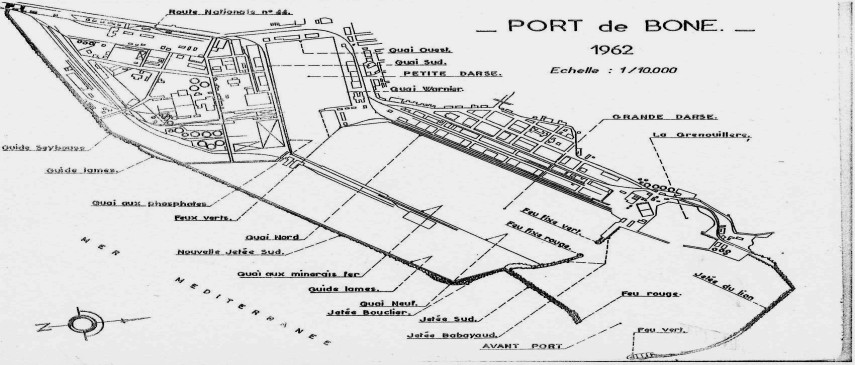
Over the last three (03) decades, the company has experienced three (03) different types of legal regimes and organizational structures:
Before November 2nd, 1982:
Operations of the organizational structures that now make up the current activity were carried out by port units attached to national parent organizations. These include:
The National Ports Office (O.N.P):
This office was responsible for centralizing and coordinating the activities of port units related to the management, operation, and development of the public port domain, but without direct involvement in purely commercial activities such as stevedoring, handling, and towing.
The role of the O.N.P was more aligned with a public service mission symbolized by port authority, rather than a direct commercial role extended to all service offerings.
However, certain units, including the port unit in Annaba,directly took on service activities: operation of the grain silo, the dry dock, the quay, and warehouses. This in fact, fell under the legal regime of th O.N.P.
THE National Handling Company (SO.NA.MA):
It was responsible for the handling operations at all ports through its units.
THE TOWING BRANCH OF THE NATIONAL SHIPPING COMPANY (CNAN):
This branch was in charge of towing activities, owing to the close connection of this service with its monopoly: maritime navigation.
From November 2, 1982 to February 29, 1989:
There was a consolidation of port activities within a single Public Enterprise of a commercial and industrial nature, possessing financial autonomy.
This organizational structure (which, at the time, was contrary to the general trend of restructuring state-owned monopolies into smaller public enterprises) aimed to provide Algerian ports with a strong structure capable of ensuring unified command. It was designed to better address the general congestion issues that characterized port transit at that time.
From February 29, 1989:
The company, while maintaining its designation as the Port Company of Annaba (abbreviated E.P.An), emerged under Law No. 88-01 of January 12, 1988, and subsequent laws, as a Public Economic Enterprise, a joint-stock company, with civil responsibility and financial autonomy.
PRESENTATION OF THE ANNABA'S PORT COMPANY
The Annaba’s Port Company abbreviated E.P.AN, was transformed into a Public Economic Port Enterprise (EPE-SPA) as of February 15, 1988. Currently, the company's share capital has been increased to 3,000,000,000 DA, fully owned by the Port Services Group, abbreviated 'SERPORT'.